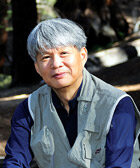
1951년 경남 마산 출생.
고려대학교 임학과와 대학원에서 산림학을 전공했다. 산림청 임목육종연구소에서 5년간 근무한 후, 미국 아이오와주립대학에서 산림생물학 석·박사학위를 받았다. 현재 국민대학교 산림자원학과 명예교수와 (재)동숭학술재단 이사장을 역임하고 있다.
문화의 창으로 숲을 읽고 해석하여 1992년부터 본격적으로 글쓰기를 시작했다. 초등학교와 중학교 국어 교과서에 그의 글이 실린 것을 보람으로 여긴다. 그가 쓴 여러 권의 저작은 대한민국 학술원, 환경부, 문화관광부, 서울시교육청, 한국출판인회, 간행물윤리위원회, 환경정의시민연대, 동아일보, 문화일보, ‘책으로 따뜻한 세상을 만드는 교사들(책따세)’ 등의 추천도서나 우수도서, 세종도서로 선정되는가 하면, 불교출판문화상, 가장 문학적인 학자상 등을 받기도 했다.
저서로는 《조선의 숲은 왜 사라졌는가》, 《숲과 한국문화》, 《나무와 숲이 있었네》, 《숲 보기 읽기 담기》, 《한국의 명품 소나무》, 《궁궐 건축재 소나무》, 《한국의 사찰 숲》, 《송광사 사찰 숲》, 《우리 소나무》, 《한 산림학도의 글쓰기》 등이 있고, 그 밖에 《森と韓國文化》(일본어판), 《The Red Pine》, 《Forests and Korean Culture》(영어판) 등을 펴냈다.
Young-woo Chun was born in Masan, South Gyeongsang Province, in 1951.He majored in forestry at Korea University, where he also completed his graduate studies. After working for five years at the Tree Breeding and Genetics Institute of the Korea Forest Service, he earned his M.S. and Ph.D. degrees in forest biology from Iowa State University, U.S.A. He is currently Professor Emeritus in the Department of Forest Resources at Kookmin University and serves as the chairman of the Dongsung Academic Foundation.
Viewing forests through the lens of culture, Prof. Chun began writing in earnest in 1992. He takes great satisfaction in knowing that some of his essays have been included in Korean language textbooks for elementary and middle school students. His works have been selected as Excellent Academic Books or Sejong Books by institutions such as the National Academy of Sciences, the Ministry of Environment, the Ministry of Culture and Tourism, the Seoul Metropolitan Office of Education, the Korean Publishers Association, the Publications Ethics Commission, and the Korea Publishing Industry Promotion Agency. He has also been honored with the Buddhist Publishing and Cultural Award and the “Most Literary Scholar” Award.
His significant books include Forests and Korean Culture, There Were Trees and Forests, Seeing, Reading, and Embracing the Forest, Korea’s Noble Pine Trees, The Red Pine for Palace Construction, Temple Forests of Korea, The Temple Forest of Songgwangsa, Our Pine Trees, and Forest Products for Royal Ceremonies in the Joseon Dynasty.He has also published the Japanese edition Mori to Kankoku Bunka (森と韓國文化) and the English editions The Red Pine and Forests and Korean Culture.
우리도 이제는 우리 숲을 누릴 자격이 있다. 그리고 우리 숲을 폄하만 할 것이 아니라 자부심을 가져야 할 때다. 무엇엔가 자부심을 느끼는 일이 억지로 되지는 않는다. 우선 그 대상을 정확히 알아야 한다. 알면 사랑하게 된다. 우리 숲에 대한 지식의 외연을 넓혀 가다보면 어느새 숲에 애착을 느끼는 자신을 발견하게 될 것이다. 이것이 바로 이 책을 세상으로 내보내는 이유이다.